

A successful major gifts programme starts with a fundraising target. While it can be tempting to jump straight to a list of potential prospects, it’s important to understand how much money you need to raise and how many prospects it will take to get you there.
Major gift fundraising always comes back to relationships, and it can take several years of cultivation before resulting in a gift. When we talk about prospect pipelines, we need to look beyond this year’s target to your organisation’s three-to-five year fundraising objective.
Define your fundraising target
Your fundraising objective should be specific, time-bound and measurable. Include how much you need to raise, the time period you’ll raise it in, and how you’ll measure if your fundraising is on track.
Before you start any fundraising, you should know what the money will fund, what constitutes a major gift to your organisation, and what size gift would be transformational. There is no standard major gift size across the sector. For some organisations, a major gift could be £5,000, and for others it might be over £25,000.
Build a table of gifts
A table of gifts is every fundraiser’s secret weapon. To build your table of gifts, break your overall fundraising target into the number and value of gifts required. For example, if your target is £1 million, you might break it into a table of gifts with a lead gift of £100,000, followed by several gifts at progressively lower levels until you reach the full £1 million target.
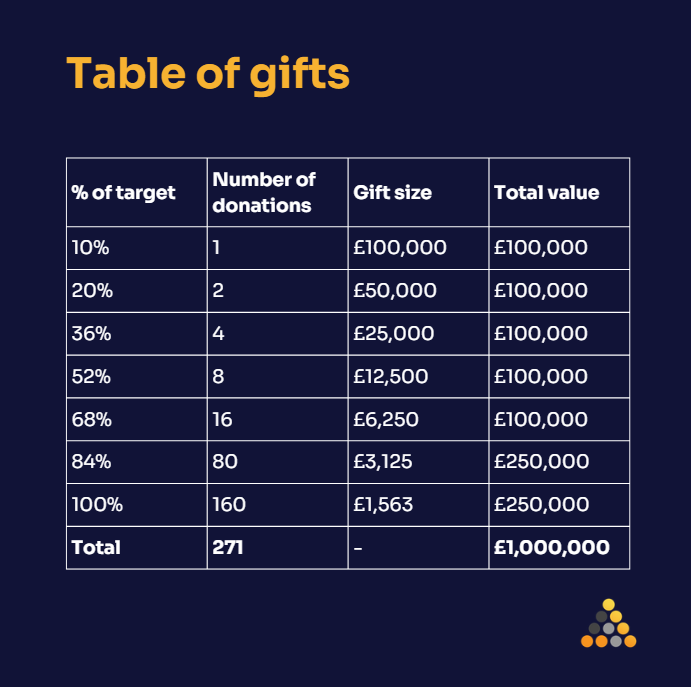
The exact breakdown will vary, but the goal of your table of gifts is to turn your fundraising target into a much clearer picture of the number and size of donations you need to secure. In turn, it helps you understand how many prospects you’ll need to deliver them.
One prospect rarely equals one major gift
We’ve seen too many boards pin their hopes on one wealthy prospect in their network, but it rarely works out that way. Our rule of thumb is 12 warm prospects = 3 hot prospects = 1 donation.
So what does that mean about their relationship with your organisation? A warm prospect is someone with the capacity to give, affinity with your organisation, and someone you can directly connect with (but haven’t yet). A hot prospect is someone you’ve met and are actively talking to about giving a major gift.
Our 12:3:1 ratio isn’t a guaranteed conversion rate, but it is a good place to start when planning the number and type of prospects you’ll need for your pipeline.
Assess your existing prospects and database
Before looking for new prospects to fill your pipeline, assess your existing ones and ensure they’re still ranked at the right level. Look at their capacity and ability to give, their affinity with your cause and their proximity and connection to your organisation.
A quick wealth screen of your database can identify people already supporting your cause who have the ability to give a transformational gift to your organisation. This is also an opportunity to identify supporters who can connect you with wealthy individuals and business leaders who might influence corporate partnerships.
Rank your prospects
A wealthy individual your board member is connected to doesn’t automatically translate into a hot prospect. We’ve seen organisations be disappointed when their list of ‘hot prospects’ didn’t result in a major gift. Usually it’s because those prospects weren’t hot at all, just a list of wealthy people they would have liked to receive a gift from.
Here’s how we rank prospects:
- Cold: can afford to give, but you don’t know if they’re interested in giving.
- Cool: can afford to give and have previously given to a similar cause.
- Lukewarm: have the ability to give and are already in your database.
- Warm: given the right treatment, you think they will give.
- Hot: you’ve met them, they’re interested, and they can make a significant gift.
- Red hot: potential donors whose behaviour indicates a major gift is likely soon.
A prospect you can reach who cares about your cause trumps a millionaire you have no connection to every time.
Map out your prospects against your table of gifts
Assign realistic potential gift levels to each prospect and map them to your table of gifts so you can see the gaps.
If you need 12 warm prospects capable of giving £25,000 and you only have three, your research brief becomes much more focused. Good prospect research starts with a brief informed by your fundraising strategy and is far more attainable than commissioning research to broadly ‘find wealthy individuals’.
Use research to fill the gaps
The best place to find new prospects is within your existing community. Look to your supporters, members, alumni, volunteers and well-connected people who can act as introducers.
Prospect research can reveal potential major donors who might only be one or two connections removed from people already supporting you.
The best pipelines are always moving
A healthy pipeline always has prospects moving through it. There are nine stages of major gift fundraising:
- Identify
- Research
- Planning approach
- Approach
- Cultivation
- Ready to ask
- Ask
- Pledge
- Stewardship
As well as pipeline stage, you need to keep assessing your prospect’s warmth. Assign prospects a value and a fundraiser, and review your pipeline regularly rather than letting it become a static CRM list.
Want to learn more about developing and managing your major gift pipeline?
In our last webinar, we looked at prospect pipelines in particular
- Understanding your fundraising target
- How many prospects do you need for your major gift pipeline?
- Hot, warm and cold prospects – how can you tell which is which?
- Generating and managing new prospects
If you missed it, you can always watch the recording, which is available on our website, along with webinars on a range of other topics.